
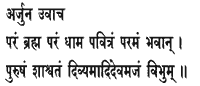
Arjuna said: Thou art the supreme Brahman, the supreme Abode, the supreme Purity, the one permanent, the divine Purusha, the original Godhead, the Unborn, the all-pervading Lord.
Beyond the Modes of Nature
Sri Aurobindo
SO FAR then extends the determinism of Nature, and what it amounts to is this that the ego from which we act is itself an instrument of the action of Prakriti and cannot therefore be free from the control of Prakriti; the will of the ego is a will determined by Prakriti, it is a part of the nature as it has been formed in us by the sum of its own past action and self-modification, and by the nature in us so formed and the will in it so formed our present action also is determined. It is said by some that the first initiating action is always free to our choice however much all that follows may be determined by that, and in this power of initiation and its effect on our future lies our responsibility. But where is that first action in Nature which has no determining past behind it, where that present condition of our nature which is not in sum and detail the result of the action of our past nature? We have that impression of a free initial act because we are living at every moment from our present on towards our future and we do not live back constantly from our present into our past, so that what is strongly vivid to our minds is the present and its consequences while we have a much less vivid hold of our present as entirely the consequence of our past; this latter we are apt to look on as if it were dead and done with. We speak and act as if we were perfectly free in the pure and virgin moment to do what we will with ourselves using an absolute inward independence of choice. But there is no such absolute liberty, our choice has no such independence. Certainly, the will in us has always to choose between a certain number of possibilities, for that is the way in which Nature always acts; even our passivity, our refusal to will, is itself a choice, itself an act of the will of Nature in us; even in the atom there is a will always at its work. The whole difference is the extent to which we associate our idea of self with the action of the will in Nature; when we so associate ourselves, we think of it as our will and say that it is a free will and that it is we who are acting. And error or not, illusion or not, this idea of our will, of our action is not a thing of no consequence, of no utility; everything in Nature has a consequence and a utility. It is rather that process of our conscious being by which Nature in us becomes more and more aware of and responsive to the presence of the secret Purusha within her and opens by that increase of knowledge to a greater possibility of action; it is by the aid of the ego-idea and the personal will that she raises herself to her own higher possibilities, rises out of the sheer or else the predominant passivity of the tamasic nature into the passion and the struggle of the rajasic nature and from the passion and the struggle of the rajasic nature to the greater light, happiness and purity of the sattwic nature. The relative self-mastery gained by the natural man over himself is the dominion achieved by the higher possibilities of his nature over its lower possibilities, and this is done in him when he associates his idea of self with the struggle of the higher guna to get the mastery, the predominance over the lower guna. The sense of free will, illusion or not, is a necessary machinery of the action of Nature, necessary for man during his progress, and it would be disastrous for him to lose it before he is ready for a higher truth. If it be said, as it has been said, that Nature deludes man to fulfil her behests and that the idea of a free individual will is the most powerful of these delusions, then it must also be said that the delusion is for his good and without it he could not rise to his full possibilities. But it is not a sheer delusion, it is only an error of standpoint and an error of placement. The ego thinks that it is the real self and acts as if it were the true centre of action and as if all existed for its sake, and there it commits an error of standpoint and placement. It is not wrong in thinking that there is something or someone within ourselves, within this action of our nature, who is the true centre of its action and for whom all exists; but this is not the ego, it is the Lord secret within our hearts, the divine Purusha, and the Jiva, other than ego, who is a portion of his being. The self-assertion of ego-sense is the broken and distorted shadow in our minds of the truth that there is a real Self within us which is the master of all and for whom and at whose behest Nature goes about her works. So too the ego’s idea of free will is a distorted and misplaced sense of the truth that there is a free Self within us and that the will in Nature is only a modified and partial reflection of its will, modified and partial because it lives in the successive moments of Time and acts by a constant series of modifications which forget much of their own precedents and are only imperfectly conscious of their own consequences and aims. But the Will within, exceeding the moments of Time, knows all these, and the action of Nature in us is an attempt, we might say, to work out under the difficult conditions of a natural and egoistic ignorance what is foreseen in full supramental light by the inner Will and Knowledge. But a time must come in our progress when we are ready to open our eyes to the real truth of our being, and then the error of our egoistic free will must fall away from us. The rejection of the idea of egoistic free will does not imply a cessation of action, because Nature is the doer and carries out her action after this machinery is dispensed with even as she did before it came into usage in the process of her evolution. In the man who has rejected it, it may even be possible for her to develop a greater action; for his mind may be more aware of all that his nature is by the self-creation of the past, more aware of the powers that environ and are working upon it to help or to hinder its growth, more aware too of the latent greater possibilities which it contains by virtue of all in it that is unexpressed, yet capable of expression; and this mind may be a freer channel for the sanction of the Purusha to the greater possibilities that it sees and a freer instrument for the response of Nature, for her resultant attempt at their development and realisation. But the rejection of free will must not be a mere fatalism or idea of natural determinism in the understanding without any vision of the real Self in us; for then the ego still remains as our sole idea of self and, as that is always the instrument of Prakriti, we still act by the ego and with our will as her instrument, and the idea in us brings no real change, but only a modification of our intellectual attitude. We shall have accepted the phenomenal truth of the determination of our egoistic being and action by Nature, we shall have seen our subjection: but we shall not have seen the unborn Self within which is above the action of the gunas; we shall not have seen wherein lies our gate of freedom. Nature and ego are not all we are; there is the free soul, the Purusha. But in what consists this freedom of the Purusha? The Purusha of the current Sankhya philosophy is free in the essence of his being, but because he is the non-doer, akart¯a; and in so far as he permits Nature to throw on the inactive Soul her shadow of action, he becomes bound phenomenally by the actions of the gunas and cannot recover his freedom except by dissociation from her and by cessation of her activities. If then a man casts from him the idea of himself as the doer or of the works as his, if, as the Gita enjoins, he fixes himself in the view of himself as the inactive non-doer, ¯atm¯anam akart¯aram, and all action as not his own but Nature’s, as the play of her gunas, will not a like result follow? The Sankhya Purusha is the giver of the sanction, but a passive sanction only, anumati, the work is entirely Nature’s; essentially he is the witness and sustainer, not the governing and active consciousness of the universal Godhead. He is the Soul that sees and accepts, as a spectator accepts the representation of a play he is watching, not the Soul that both governs and watches the play planned by himself and staged in his own being. If then he withdraws the sanction, if he refuses to acknowledge the illusion of doing by which the play continues, he ceases also to be the sustainer and the action comes to a stop, since it is only for the pleasure of the witnessing conscious Soul that Nature performs it and only by his support that she can maintain it. Therefore it is evident that the Gita’s conception of the relations of the Purusha and Prakriti are not the Sankhya’s, since the same movement leads to a quite different result, in one case to cessation of works, in the other to a great, a selfless and desireless, a divine action. In the Sankhya Soul and Nature are two different entities, in the Gita they are two aspects, two powers of one selfexistent being; the Soul is not only giver of the sanction, but lord of Nature, Ishwara, through her enjoying the play of the world, through her executing divine will and knowledge in a scheme of things supported by his sanction and existing by his immanent presence, existing in his being, governed by the law of his being and by the conscious will within it. To know, to respond to, to live in the divine being and nature of this Soul is the object of withdrawing from the ego and its action. One rises then above the lower nature of the gunas to the higher divine nature. The movement by which this ascension is determined results from the complex poise of the Soul in its relations with Nature; it depends on the Gita’s idea of the triple Purusha. The Soul that immediately informs the action, the mutations, the successive becomings of Nature, is the Kshara, that which seems to change with her changes, to move in her motion, the Person who follows in his idea of his being the changes of his personality brought about by the continuous action of her Karma. Nature here is Kshara, a constant movement and mutation in Time, a constant becoming. But this Nature is simply the executive power of the Soul itself; for only by what he is, can she become, only according to the possibilities of his becoming, can she act; she works out the becoming of his being. Her Karma is determined by Swabhava, the own-nature, the law of self-becoming of the soul, even though, because it is the agent and executive of the becoming, the action rather seems often to determine the nature. According to what we are, we act, and by our action we develop, we work out what we are. Nature is the action, the mutation, the becoming, and it is the Power that executes all these; but the Soul is the conscious Being from which that Power proceeds, from whose luminous stuff of consciousness she has drawn the variable will that changes and expresses its changes in her actions. And this Soul is One and Many; it is the one Life-being out of which all life is constituted and it is all these living beings; it is the cosmic Existent and it is all this multitude of cosmic existences, sarvabhu¯ ta¯ni, for all these are One; all the many Purushas are in their original being the one and only Purusha. But the mechanism of the ego-sense in Nature, which is part of her action, induces the mind to identify the soul’s consciousness with the limited becoming of the moment, with the sum of her active consciousness in a given field of space and time, with the result from moment to moment of the sum of her past actions. It is possible to realise in a way the unity of all these beings even in Nature herself and to become aware of a cosmic Soul which is manifest in the whole action of cosmic Nature, Nature manifesting the Soul, the Soul constituting the Nature. But this is to become aware only of the great cosmic Becoming, which is not false or unreal, but the knowledge of which alone does not give us the true knowledge of our Self; for our true Self is always something more than this and something beyond it. For, beyond the soul manifest in Nature and bound up with its action, is another status of the Purusha, which is entirely a status and not at all an action; that is the silent, the immutable, the all-pervading, self-existent, motionless Self, sarvagatam acalam, immutable Being and not Becoming, the Akshara. In the Kshara the Soul is involved in the action of Nature, therefore it is concentrated, loses itself, as it were, in the moments of Time, in the waves of the Becoming, not really, but only in appearance and by following the current; in the Akshara Nature falls to silence and rest in the Soul, therefore it becomes aware of its immutable Being. The Kshara is the Sankhya’s Purusha when it reflects the varied workings of the gunas of Nature, and it knows itself as the Saguna, the Personal; the Akshara is the Sankhya’s Purusha when these gunas have fallen into a state of equilibrium, and it knows itself as the Nirguna, the Impersonal. Therefore while the Kshara, associating itself with the work of Prakriti, seems to be the doer of works, kart¯a, the Akshara dissociated from all the workings of the gunas is the inactive non-doer, akart¯a, and witness. The soul of man, when it takes the poise of the Kshara, identifies itself with the play of personality and readily clouds its self-knowledge with the ego-sense in Nature, so that he thinks of himself as the ego-doer of works; when it takes its poise in the Akshara, it identifies itself with the Impersonal and is aware of Nature as the doer and itself as the inactive witnessing Self, akart¯aram. The mind of man has to tend to one of these poises, it takes them as alternatives; it is bound by Nature to action in the mutations of quality and personality or it is free from her workings in immutable impersonality. But these two, the status and immutability of the Soul and the action of the Soul and its mutability in Nature, actually coexist. And this would be an anomaly irreconcilable except by some such theory as that of Maya or else of a double and divided being, if there were not a supreme reality of the Soul’s existence of which these are the two contrary aspects, but which is limited by neither of them.We have seen that theGita finds this in the Purushottama. The supreme Soul is the Ishwara, God, the Master of all being, sarvaloka-mahe´svara. He puts forth his own active nature, his Prakriti,—sv¯a ˙ mprakr. tim, says the Gita,—manifest in the Jiva, worked out by the svabh¯ava, “own-becoming”, of each Jiva according to the law of the divine being in it, the great lines of which each Jiva must follow, but worked out too in the egoistic nature by the bewildering play of the three gunas upon each other, gun. ¯a gun. es.u vartante. That is the traigun.yamay¯ı m¯ay¯a, the Maya hard for man to get beyond, duratyay¯a,—yet can one get beyond it by transcending the three gunas. For while all this is done by the Ishwara through his Nature-Power in the Kshara, in the Akshara he is untouched, indifferent, regarding all equally, extended within all, yet above all. In all three he is the Lord, the supreme Ishwara in the highest, the presiding and all-pervading Impersonality, prabhu and vibhu, in the Akshara, and the immanent Will and present active Lord in the Kshara. He is free in his impersonality even while working out the play of his personality; he is not either merely impersonal or personal, but one and the same being in two aspects; he is the impersonalpersonal, nirgun.o gun. ¯ı, of the Upanishad. By him all has been willed even before it is worked out,—as he says of the still living Dhartarashtrians, “already have they been slain by Me,” may¯a nihata¯h. pu¯rvam eva,— and the working out by Nature is only the result of his Will; yet by virtue of his impersonality behind he is not bound by his works, kart¯aram akart ¯aram. But man as the individual self, owing to his ignorant selfidentification with the work and the becoming, as if that were all his soul and not a power of his soul, a power proceeding from it, is bewildered by the ego-sense. He thinks that it is he and others who are doing all; he does not see that Nature is doing all and that he is misrepresenting and disfiguring her works to himself by ignorance and attachment. He is enslaved by the gunas, now hampered in the dull case of tamas, now blown by the strong winds of rajas, now limited by the partial lights of sattwa, not distinguishing himself at all from the nature-mind which alone is thus modified by the gunas. He is thereforemastered by pain and pleasure, happiness and grief, desire and passion, attachment and disgust: he has no freedom. He must, to be free, get back from the Nature action to the status of the Akshara; he will then be trigun. ¯ at¯ıta, beyond the gunas. Knowing himself as the Akshara Brahman, the unchanging Purusha, he will know himself as an immutable impersonal self, the Atman, tranquilly observing and impartially supporting the action, but himself calm, indifferent, untouched, motionless, pure, one with all beings in their self, not one with Nature and her workings. This self, though by its presence authorising the works of Nature, though by its all-pervading existence supporting and consenting to them, prabhu vibhu, does not itself create works or the state of the doer or the joining of the works to their fruit, na kartr.tva ˙ m na karm¯an.i sr. jati na karma-phalasam ˙ yogam, but only watches nature in the Kshara working out these things, svabh¯avas tu pravartate; it accepts neither the sin nor the virtue of the living creatures born into this birth as its own, na¯datte kasyacit pa¯pam˙ na caiva sukr.tam; it preserves its spiritual purity. It is the ego bewildered by ignorance which attributes these things to itself, because it assumes the responsibility of the doer and chooses to figure as that and not as the instrument of a greater power, which is all that it really is; ajn˜ a¯nena¯vr.tam˙ jn˜a¯nam˙ tena muhyanti jantavah. . By going back into the impersonal self the soul gets back into a greater selfknowledge and is liberated from the bondage of the works of Nature, untouched by her gunas, free from her shows of good and evil, suffering and happiness. The natural being, the mind, body, life, still remain, Nature still works; but the inner being does not identify himself with these, nor while the gunas play in the natural being, does he rejoice or grieve. He is the calm and free immutable Self observing all. Is this the last state, the utmost possibility, the highest secret? It cannot be, since this is a mixed or divided, not a perfectly harmonised status, a double, not a unified being, a freedom in the soul, an imperfection in the Nature. It can only be a stage.What then is there beyond it? One solution is that of the Sannyasin who rejects the nature, the action altogether, so far at least as action can be rejected, so that there may be an unmixed undivided freedom; but this solution, though admitted, is not preferred by the Gita. The Gita also insists on the giving up of actions, sarvakarm ¯an. i sannyasya, but inwardly to the Brahman. Brahman in the Kshara supports wholly the action of Prakriti, Brahman in the Akshara, even while supporting, dissociates itself from the action, preserves its freedom; the individual soul, unified with the Brahman in the Akshara, is free and dissociated, yet, unified with the Brahman in the Kshara, supports but is not affected. This it can do best when it sees that both are aspects of the one Purushottama. The Purushottama, inhabiting all existences as the secret Ishwara, controls the Nature and by his will, now no longer distorted and disfigured by the ego-sense, the Nature works out the actions by the swabhava; the individual soul makes the divinised natural being an instrument of the divine Will, nimitta-m¯atram. He remains even in action trigun. ¯ at¯ıta, beyond the gunas, free from the gunas, nistraigun. ya, he fulfils entirely at last the early injunction of the Gita, nistraigun. yo bhav¯arjuna. He is indeed still the enjoyer of the gunas, as is the Brahman, though not limited by them, nirgun. a ˙ m gun. abhoktr. ca, unattached, yet all-supporting, even as is that Brahman, asaktam˙ sarvabhr.t: but the action of the gunas within him is quite changed; it is lifted above their egoistic character and reactions. For he has unified his whole being in the Purushottama, has assumed the divine being and the higher divine nature of becoming, madbh¯ava, has unified even his mind and natural consciousness with theDivine, manman¯amaccittah. . This change is the final evolution of the nature and the consummation of the divine birth, rahasyam uttamam. When it is accomplished, the soul is aware of itself as the master of its nature and, grown a light of the divine Light and will of the divine Will, is able to change its natural workings into a divine action.
Sri Aurobindo
 About Us| ©1999 - 2009 searchforlight.org
All extracts and quotations from the written works of Sri Aurobindo and the Mother and the Photographs of
the Mother and Sri Aurobindo are copyright Sri Aurobindo Ashram Trust, Pondicherry -605002 India.